Digital Cameras - Sony Cyber-Shot DSC-P7 Test Images
(Original test posting: 07/08/02)
| I've begun including links in our reviews to a Thumber-generated index page for our test shots. The Thumber data includes a host of information on the images, including shutter speed, ISO setting, compression setting, etc. Rather than clutter the page below with *all* that detail, I'm posting the Thumber index so only those interested in the information need wade through it! |
| Outdoor
Portrait:
Great resolution and detail, with nearly accurate color. The extreme tonal range of this image makes it a tough shot for many digicams, which is precisely why I set it up this way. The object is to hold highlight and shadow detail without producing a "flat" picture with muddy colors, and the DSC-P7 handled the challenge very well. The shot at right was taken with a +0.3 EV exposure compensation adjustment, which manages to brighten the midtones without losing highlight detail. The Auto and Daylight white balance settings produced nearly identical results, both just a hint warm. Marti's skin tones look pretty good, but the blue flowers in the bouquet are just a little purplish (a common problem with this shot). The red flower in the bouquet borders on being too bright and oversaturated. Resolution is high, with a lot of fine detail in the flower bouquet and in Marti's features. Detail remains strong in the shadows, with moderate noise. A good performance overall. To view the entire exposure series from -0.3 to +1.3 EV, see files P7OUTAM1.HTM through P7OUTAP4.HTM on the thumbnail index page. |
||||||||||||||||||
|
Overall results are similar to the wider shot above, and the DSC-P7's 3x zoom lens helps prevent distortion of Marti's features. This photo also required a +0.3 EV exposure compensation adjustment, somewhat unusual in this closer shot. Midtone values are fairly bright however, and the highlights hold onto detail pretty well also. Marti's face and hair show even more fine detail, with good sharpness. Shadow details are also strong, with moderate noise. To view the entire exposure series from -0.3 to +1.0 EV, see files P7FACAM1.HTM through P7FACAP3.HTM on the thumbnail index page. |
||||||||||||||||||
|
Indoor Portrait, Flash:
Default flash intensity is a little low, but exposure looks good with the "High" setting. The DSC-P7's flash underexposes a little at its default intensity setting. The background incandescent lighting results in an orange cast, which decreases slightly at the High intensity setting. (The Low intensity setting results in an even darker image, with a stronger orange cast.) I also shot with the camera's Slow-Sync flash mode, again snapping images with the High, Normal, and Low intensity settings. In this series, the High intensity setting also produced the best results. The longer exposure time brightened the image slightly and eliminated the bluish light from the flash, but also increased the orange cast on Marti. |
||||||||||||||||||
|
Indoor Portrait, No Flash:
Best exposure with Twilight mode, only a little trouble with the incandescent light source. This shot is always a very tough test of a camera's white balance capability, given the strong, yellowish color cast of the household incandescent bulbs used for the lighting. The DSC-P7 had fewer problems that most cameras I test interpreting this difficult light source, producing only a slightly warm cast with the Auto white balance setting, but a very yellow cast with Incandescent white balance settings. The Auto version doesn't look at all bad though, preserving enough of the warmth of the original lighting to carry the "mood" of the shot, but not so much as to significantly distort the colors. I shot with the camera's Twilight exposure mode, for the longer exposure times it provides, but as on other model-year 2002 Sony cameras, I found that the Twilight mode required a lot of positive exposure compensation to get a good exposure. The main shot has a +1.7 EV exposure adjustment, a larger adjustment than most cameras require for this shot. (Click here for an example at the default exposure setting.) Despite the warm cast, skin tones look pretty good. The warm cast doesn't help with the blue flowers of the bouquet, which appear purple instead (these blues are often difficult for many digicams). To view the entire exposure series from +1.0 to +2.0 EV, see files P7INTWAP3.HTM through P7INTWAP6.HTM on the thumbnail index page. ISO Series:
|
||||||||||||||||||
|
House Shot:
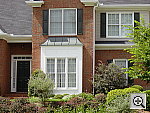
Color balance is little warm, exposure a bit bright. Detail and resolution are good, but not up to the level of the best full-sized three megapixel cameras. In this shot, the Auto and Daylight white balance settings produced nearly identical, slightly warm results. The white trim of the Auto setting looked more accurate, so I chose it for the main shot. The P7 somewhat overexposed this shot, as the white trim is a little blown out. Resolution is fairly high, with good detail in the tree limbs above the roof and in the shrubbery in front of the house, but the image isn't as sharp as the best full-sized three megapixel cameras. (Such as Sony's own tack-sharp DSC-S75.) Still, for a compact/subcompact camera, the DSC-P7 does quite well. The image is about equally sharp overall, with only a little softening in all four corners. A good job overall. |
||||||||||||||||||
|
Far-Field Test 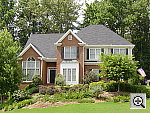
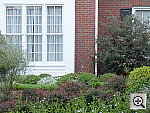
Good resolution and detail, though slightly limited dynamic range. This image is shot at infinity to test far-field lens performance. NOTE that this image cannot be directly compared to the other "house" shot, which is a poster, shot in the studio. The rendering of detail in the poster will be very different than in this shot, and color values (and even the presence or absence of leaves on the trees!) will vary in this subject as the seasons progress. In general though, you can evaluate detail in the bricks, shingles and window detail, and in the tree branches against the sky. Compression artifacts are most likely to show in the trim along the edge of the roof, in the bricks, or in the relatively "flat" areas in the windows. This is my ultimate "resolution shot," given the infinite range of detail in a natural scene like this, and the DSC-P7 does a good job with it, very much in line with its three megapixel resolution. Resolution is high, with a lot of fine detail in the tree limbs above the roof, as well as in the fine foliage in front of the house. Though the leaf and branch details in the tree limbs above the roof are slightly soft, they are well-defined. The image is slightly overexposed, and the camera captures only the strongest details in the bright, white paint around the bay window, due to the harsh sunlight. The shadow area above the front door fares better, with good detail in the brick pattern and on the door panels. The Auto white balance setting produces good color, though the green values appear bright, a bit oversaturated, and slightly yellowish. The table below shows our standard resolution and quality series, followed by ISO and Sharpness series. Resolution Series:
ISO Series:
Sharpness Series:
|
||||||||||||||||||
|
Lens Zoom Range Typical 3x zoom range. I routinely shoot this series of images to show the field of view for each camera, with the lens at full wide angle, at maximum telephoto (3x, in this case), and at full telephoto with the digital zoom enabled. The DSC-P7's lens is equivalent to a 39-117mm zoom on a 35mm camera. (A slight wide angle to a modest telephoto. - A slight bias toward the telephoto end, as compared to the typical 35-105mm equivalent range of most digicams.) Following are the results at each zoom setting.
|
||||||||||||||||||
|
Musicians Poster
Color balance is slightly warm, but detail is good. This shot is typically a tough test for digicams, as the abundance of blue in the composition often tricks white balance systems into producing a warm color balance. The DSC-P7 fell victim to this trap, as both the Auto and Daylight white balance settings resulted in slightly warm color balances. The Daylight setting was the better-balanced of the two, so I chose it for the main image. The slight warm cast results in reddish tints in the blue background, and gives the blue robe a greenish tint in the highlights. The shadow areas of the blue robe are slightly purplish, a common problem with this shot. Resolution is moderately high, judging by the embroidery details of the blue robe. The flower garland and beaded necklaces of the other models also show good detail. |
||||||||||||||||||
|
Macro Shot
About average macro performance, flash has some trouble. The DSC-P7 turned in about an average performance in the macro category, capturing a minimum area of 3.81 x 2.86 inches (96.84 x 72.63 millimeters). Resolution is high, with good detail in the dollar bill, coins, and brooch. Details are reasonably sharp throughout most of the frame, though the corners are a hint soft, and there's noticeable barrel distortion. Color is about right with the Auto white balance. The DSC-P7's flash had trouble throttling down for the macro area, overexposing the shot. Still, macro performance without the flash is good. (Just plan on using an external light source for any close-in macro shots.) |
||||||||||||||||||
|
"Davebox" Test Target
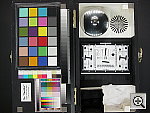
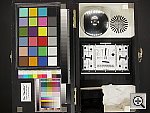
Very slight warm color cast, but good exposure, excellent color. The Auto white balance setting produced the best color here, as the Daylight setting resulted in a warmer cast. Overall color balance is still just a bit yellowish with the Auto white balance setting, but the large color blocks on the MacBeth target look very good. Saturation is just about perfect, and none of the colors show any significant weakness. (Although the dark blue swatch at bottom center is a bit lighter than it should be.) The DSC-P7 distinguishes the subtle tonal variations of the Q60 target up to the "B" range, and the grayscales show good detail as well. The shadow area of the charcoal briquettes shows good detail, and noise is moderately low. ISO Series:
|
||||||||||||||||||
|
Low-Light Tests Sensitive enough for average city street lighting, and possible a bit darker. Exposure is automatically controlled on the DSC-P7, which limits the camera's low-light shooting abilities. Like a handful of other Cyber-Shot models, the camera's Twilight mode doesn't allow you to adjust the ISO setting, which further limits low-light performance. The DSC-P7 captured bright, clear images at light levels as low as one foot-candle (11 lux), though you could arguably use images shot at the 1/2 foot-candle (5.5 lux) as well (the darker shot shows a bit of a pink color cast as well). Typical city street lighting equates to about one foot-candle, so conditions darker than that will require the built-in flash. Color is good with the Auto white balance setting, and noise is moderately low. The table below shows the best exposure we were able to obtain for each of a range of illumination levels. Images in this table (like all of our sample photos) are untouched, exactly as they came from the camera.
|
||||||||||||||||||
|
Flash Range Test Bright to 12 feet, very good intensity as far as 14 feet. The DSC-P7's flash maintained surprisingly good intensity all the way to 14 feet from the test target. Flash power was brightest at eight feet, and only decreased slightly with each foot of distance. There was some falloff beyond 12 feet though, so I'd rate it at a usable range of 12 feet. Below is our flash range series, with distances from eight to 14 feet from the target.
|
||||||||||||||||||
|
ISO-12233 (WG-18) Resolution Test
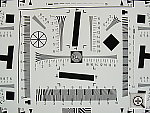
The DSC-P7 performed well on the "laboratory" resolution test chart. It started showing artifacts in the test patterns at resolutions as low as 800 lines per picture height vertically and as low as 600 lines horizontally. I found "strong detail" out to 1,100 lines horizontally and 1,050 lines vertically. "Extinction" of the target patterns occurred at about 1,350 lines. Overall, the P7's performance is very much in line with the three megapixel resolution of its CCD. - It's perhaps a tad less sharp than the very best full-sized three megapixel cameras, but not by much. Optical distortion on the DSC-P7 is quite high at the wide-angle end, as I measured a 1.1 percent barrel distortion. The telephoto end fared a little better, as I measured a 0.34 percent barrel distortion. Chromatic aberration is slight, showing about two faint pixels of coloration on either side of the target lines. (This distortion is visible as a very slight colored fringe around the objects at the edges of the field of view on the resolution target.) Resolution Series, Wide Angle
Telephoto
Sharpness
|
||||||||||||||||||
|
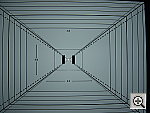
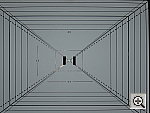
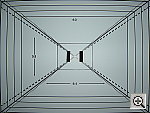
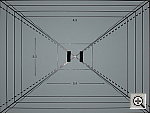
Viewfinder Accuracy/Flash Uniformity Tight optical viewfinder, but very accurate LCD monitor. The DSC-P7's optical viewfinder is rather tight, showing about 79 percent of the final frame at both wide angle and telephoto lens settings. The LCD monitor was much more accurate, showing approximately 98.5 percent of the frame at wide angle. At telephoto, frame accuracy was nearly 100 percent, though the measurement lines were just outside the frame (but probably within the margin of error of the test). Given that I generally prefer LCD monitors to be as close to 100 percent accuracy as possible, the DSC-P7 does an excellent job in that regard, although I'd like to see a more accurate optical finder. Flash illumination at wide angle falls off at the corners and edges of the frame, but is more even at telephoto.
|
















Follow Imaging Resource: