A "Universal" Digicam Power Pack
Digipower develops a powerful, nearly universal external battery pack� in a slick package.
Review Date: August 2002
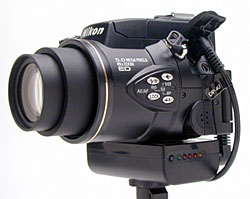 |
|
High-capacity LiIon-powered external battery pack. |
|
|
Slick design, mounts to camera's tripod socket. | |
|
|
Full set of adapter cables provided, compatible with nearly 200 digital cameras and camcorders. | |
|
|
Handy "gas gauge" display shows remaining capacity. | |
|
|
Available online from Ritzcamera.com for $69.95. |
Introduction
Second only to shutter lag (my personal number one pet peeve), battery life is probably the single biggest complaint most digicam owners would have about their camera. While strides have been made in the last year or two to reduce power consumption, there's just no avoiding the fact that digicams have hefty appetites for power. For casual shooters, this may not be a big issue, since it's easy enough to pack along a spare battery or a set of them for an extended outing. If you're a real "enthusiast" user (fanatic?) though, you can quickly end up carrying several sets of batteries with the attendant hassle of keeping them organized and paying attention to which sets are used, and which are still fresh. Worse, Murphy's law applies in spades to digicam battery life. The batteries are always destined to go dead just as the most compelling shot of the day happens by. - And it's no help having a spare set in your pocket if the critical moment is right now. You're still dead in the water for at least a few precious seconds.
To address the problem of short battery life, several manufacturers have developed external battery packs to provide extra juice for long shooting sessions. To date, most of these have consisted of a belt-mounted battery pack with a coiled cord that goes to the camera's external power jack. These work well enough (quite well, in fact), but the long power cord stretching to your belt can get in the way. - And if you want to use the camera on a tripod, you have to resort to some sort of a cobbled-together strap arrangement to hang the pack from the tripod.
Now though, Digipower has come up with a unique solution to the external-battery dilemma, in the process creating the most universal external pack to date. With the provided cables and adapters, it can power just about any consumer or prosumer-level camera out there, something no pack to date has managed to achieve. The new battery pack is called the DPS-9000, and is overall one of the slickest external power solutions I've yet seen.
Design
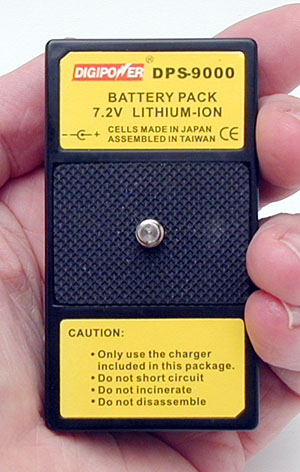
The basic unit is a flat, rectangular box with rounded edges on the bottom side. Overall dimensions are (very roughly) an inch thick, an inch and three quarters wide, and three and a half inches long. The only external connection is a power jack on one side.
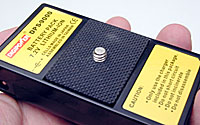
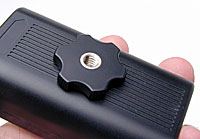
A 1/4 inch threaded bolt extends completely through the case, from top to bottom. The head of this bolt itself has a 1/4 inch threaded socket in it. The combination lets you screw the DPS-9000 into a camera's tripod socket, and then bolt the whole pack/camera combination onto a tripod
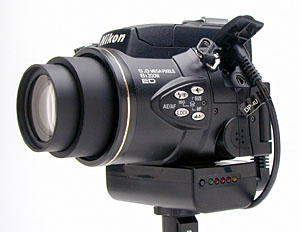
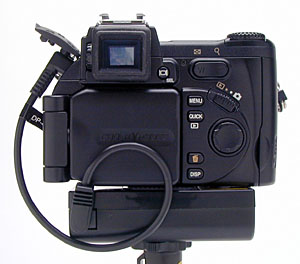
The tripod-mount design is a great idea, as it directly couples the pack to the camera, eliminating any problems with long tether cables. The mounting screw itself has a 1/4 inch tripod socket at the bottom, making it easy to just bolt the whole pack/camera combination onto a tripod as a unit. While having the pack directly attached to the camera does add to the camera's in-hand weight and bulk, I think the combination is still more ergonomic than the separate pack/cable arrangements employed by other external packs. The photo above shows the DPS-9000 attached to a Nikon Coolpix 5700.
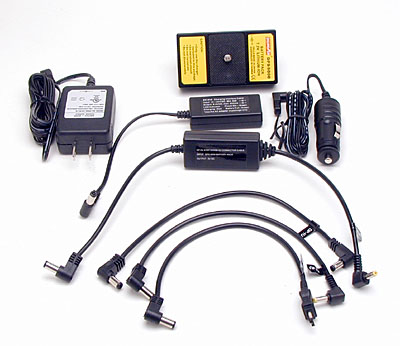
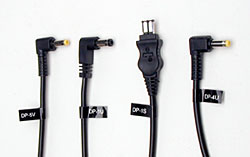
There's a lot in the package with the DPS-9000: Four separate adapter cables to match it to various cameras, an AC power supply and charging adapter for recharging the pack, and a cigarette lighter adapter for recharging while you're on the road.
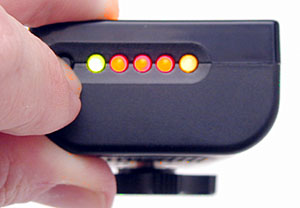
There's a "gas gauge" display on one end of the pack itself. Pressing a small button illuminates from 1-5 LEDs, giving a rough idea of the pack's remaining capacity.
�
Compatibility
 I
mentioned that the DPS-9000 is the most "universal" pack I've seen
to date. This is thanks to the very complete kit of adapter cables that are
included in the package with it. Included are cables with 4.0 and 4.7mm plugs,
a special 5 volt (regulated) stepdown adapter for Fuji cameras, and even a connector
that fits the DC-in jacks on many Sony digicams. (This is the first time I've
seen a third party company provide an adapter to fit the proprietary Sony power
connector. One important note about using the DPS-9000 with Sony digicams however:
Since the cameras with the style connector provided with the DPS-9000 all incorporate
internal battery-charging circuitry, you should remove the internal battery
if you're going to be running from the DPS-9000. The reason for this is that
the camera will use the power from the DPS-9000 to charge its internal battery,
potentially shortening overall run time, since the internal charger won't be
100% efficient.)
I
mentioned that the DPS-9000 is the most "universal" pack I've seen
to date. This is thanks to the very complete kit of adapter cables that are
included in the package with it. Included are cables with 4.0 and 4.7mm plugs,
a special 5 volt (regulated) stepdown adapter for Fuji cameras, and even a connector
that fits the DC-in jacks on many Sony digicams. (This is the first time I've
seen a third party company provide an adapter to fit the proprietary Sony power
connector. One important note about using the DPS-9000 with Sony digicams however:
Since the cameras with the style connector provided with the DPS-9000 all incorporate
internal battery-charging circuitry, you should remove the internal battery
if you're going to be running from the DPS-9000. The reason for this is that
the camera will use the power from the DPS-9000 to charge its internal battery,
potentially shortening overall run time, since the internal charger won't be
100% efficient.)
The list of cameras Digipower claims are compatible with the DPS-9000 is a long one. (Click here for a scanned copy of the compatibility chart that was packed with the unit I tested.) Given the constant flood of new digicam models on the market, it's probably no surprise that the compatibility chart didn't list some recent models that are compatible with the DPS-9000. (In particular, it doesn't show the new Nikon 4500 and 5700, both of which work just fine with the DSP-9000 based on my own testing. Likewise, it doesn't show the Sony CD-250 or CD-400 either, and I can confirm that the CD-400 works well with it.)
True 5 Volt Output
A nice touch with the DPS-9000 is that it comes with a little adapter for use with cameras calling for 5 volt power input. (The entire Fuji line of cameras, for instance.) The nice part about the DSP-9000's implementation of the 5v adapter is that it uses a true voltage regulator, rather than the voltage-dropping diode used by some other units. (I verified this with my own tests, across a range of 0 to about 1250 milliamps. The output voltage doesn't start to fall off until a power drain of around 1300 mA.) This means that the output voltage of the DPS-9000's 5v adapter will hold constant as the pack discharges. - This could translate into longer run times for 5v cameras, although I didn't test this.
"High Power" Cameras - Semi Compatible?
I know from past experience that some high power-drain cameras are problematic when used with external battery packs, even when the voltage rating of the pack and the camera's input spec seem to be compatible. A case in point is the Minolta Dimage 7/7i. That camera shows a voltage spec on its external power jack of 6.5 volts, but I've found in the past that it required a LiIon pack with an 8.4 volt output to power it properly. I happened to have a Dimage 7 on hand, waiting for me to take a look at the latest firmware upgrade from Minolta. I've used this camera successfully with Maha's LiIon "PowerBank" external battery pack with good results, but when I plugged the D7 into the DPS-9000, it wouldn't power up properly. - The camera turned on, but the rear panel LCD wouldn't light up. Switching to the D7's electronic viewfinder (which has a lower power drain), the camera worked normally. I could even snap photos with the rear panel LCD enabled, I just couldn't see what I was doing.
The Dimage 7 and 7i are particularly demanding cameras from a power standpoint, so my experience with the D7 may very well be unique to that model. (It doesn't even seem to be a matter of the pack's ability to handle high power drains, but may possibly be an issue with noise voltages appearing in response to large, short spikes in current demand when the LCD backlight tries to start up.) Still, it does appear that you should actually test the DPS-9000 with a camera, if you suspect it has a very high power drain.
A cautionary note?
The one hesitation I have about the DPS-9000 is that its output voltage ranged from 8.3 down to 7.2 volts in my tests, depending on how fully charged it was, and the power drain I placed on it. Most digicams call for voltages of 6 or 6.5 volts at their external power terminals. In my extensive experience doing power-consumption tests on digicams, I've found that cameras can generally accept a pretty wide range of voltages without problem or complaint. So, while the vast majority of digicams may do just fine with the DPS-9000's output voltage range. Because the DPS-9000's actual output voltage (8 volts or over, rather than the 7.2 volts it's rated at) is higher than the official specs for most digicams, I felt compelled to make mention of it.
In this vein though, it's also worth noting that the vast majority of external power packs on the market deliver 7.2 volts, which is above the nominal 6-6.5 volt input spec of most cameras anyway. - An additional 0.8-1.0 volts may not be much of an issue. I've also found that some cameras (like the Minolta Dimage 7 or Olympus E-10/20) really need to see more than 7.2 volts from a power pack to operate properly anyway.
So, probably no big deal, but I did feel I should mention, particularly since the DPS-9000's nominal output voltage is actually higher than that marked on its label.
Performance
In a word, excellent. Although it had some trouble with the Dimage 7, the DSP-9000 worked beautifully with all the other digicams I tried it with. I didn't do any sort of an exhaustive test, but a half-dozen different cameras from as many different manufactures all worked flawlessly.
I don't routinely do any sort of capacity testing for external battery packs, but the DSP-9000 certainly seems to pack a punch. As an informal test, I ran a Nikon 5700 from it until it ran out of juice, with the camera set to its worst-case power consumption mode. (Capture mode, with the rear-panel LCD screen on.) Even with the camera running in its worst-case power mode, the DPS-9000 kept the camera running for nearly four hours. (!) This was an excellent performance, a good bit beyond my expectations for the unit.
I also found the little "gas gauge" LEDs on the side of the unit quite useful - As the test wore on, progressively fewer lights lit, giving me a pretty good idea of how much charge was remaining.
Bottom Line
This looks like a real winner to me - I really like the way the DPS-9000 just bolts onto the camera's tripod socket. This seemed much more convenient than the belt-mounted packs I've used in the past, although it does add a fair bit to the weight of the camera. I also liked how versatile it was - It's big news indeed that there's finally an external power pack that will fit Sony digicams and camcorders, welcome relief to serious Sony shooters. It worked well with every camera I tried it on, with the exception of the Minolta Dimage 7. Also, while I don't have any formal basis of comparison for battery pack capacity, the DPS-9000 powered typical digicams for a long time.
Finding One
Digipower tells me that the DPS-9000 should be appearing in national photo and electronics chains like Ritz Camera, CompUSA and Best Buy soon. See the shopping links below.
